
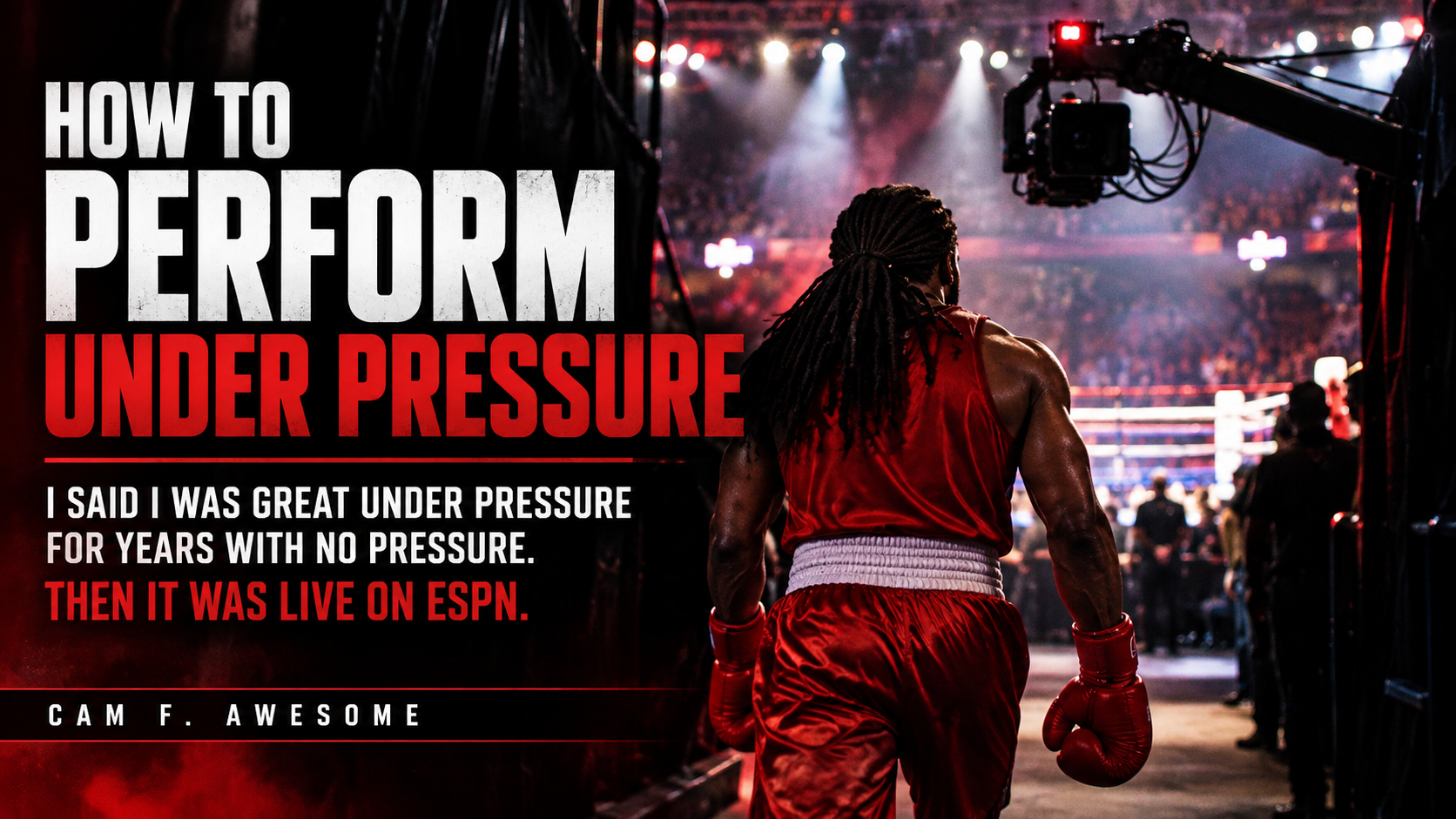
The things that take no talent are the habits anybody can do on day one: being on time, being prepared, keeping your word, asking good questions, giving full effort. None of them need a gift. All of them build your reputation.
I'm Cam F. Awesome. I retired from boxing with 12 national titles and more wins than any boxer in USA Boxing history, and I call myself Mr. TNT, because I do the things that take no talent. That's not modesty. It's the actual explanation for how a kid went from bullied to national champion.
When I joined the boxing gym in 11th grade, I had never made a team. Everybody in there was jacked, had abs, and didn't trip over their own feet. I wasn't that.
So I showed up early, asked good questions, and gave full effort, and after about six months I had caught up to all the naturally gifted boxers. From there, the only thing that separated us was our ability to work hard.
Below is the complete list, the one habit that has paid me back the most, and how to run it with your team this week.
The Complete List of Things That Take No Talent
Here's the full TNT list, the way I'd say it out loud:
Being prepared
Being on time
Keeping your word
Listening
Asking good questions
Taking notes
Remembering names
Communicating clearly
Bringing good energy
Accepting feedback
Being curious
Doing what you say you'll do
Triple checking your work
Taking ownership
Admitting when you're wrong
Giving credit
Being kind
Being respectful
Being consistent
Being patient
Paying attention
Making eye contact
Asking, "How can I help?"
Asking the six powerful words: "What can I do for you?"
Rehearsing
Being willing to look stupid in order to learn
Looking for solutions instead of complaining
Treating invisible people like they matter
Leaving things better than you found them
Doing the job when no one is watching
Actually caring
That last one is number one. If you actually care, you'll just try harder at every other thing on the list.
A few of these I learned the expensive way. Triple checking your work is on here because in 2012 I won the Olympic Trials and then lost my spot on the Olympic team over paperwork I didn't fill out. Being willing to look stupid is on here because the first time my coach told me to spar, a room full of intimidating people laughed at me, and I went and got a mouthpiece anyway. Accepting feedback is on here because I still send emails to bureau agents that say: I don't need positive feedback, I need honest feedback.
The things that take no talent are the things that build your reputation. They're also the front end of how to build a championship mindset: the confidence comes from the work nobody saw.
Things That Require No Talent Aren't Easy. They're Inconvenient.
"No talent required" doesn't mean easy. It means inconvenient, and that's exactly why most people skip it.
Heavyweights don't like running. They'll lift weights and look big and strong, but they're not doing cardio. It takes zero talent to put on your shoes and go for a three mile run. It's inconvenient, it's not fun, and some days it's raining.
That's when it clicked for me: I'm willing to tolerate inconvenience to be great. In a boxing gym, you can usually rank who's best by who has the most fights, because that person has been around the longest and been in the ring with the most talented people. So my plan was to deal with the inconvenience of fighting a lot, losing a bunch, always being in shape, running when it's raining, and missing birthday parties, Christmas, and weddings to train. That gave me an edge.
The hardest part is knowing what "a lot" looks like
Working hard is completely subjective. There's someone who sits at a desk all day in air conditioning, with an ergonomic chair and Wi-Fi, and thinks they worked hard after eight hours. There's also a woman mining cobalt 16 hours a day with a baby strapped to her back, and she thinks she's working hard too.
When the average person says they're going to work on their speech a lot, they'll run it five or six times over the course of a year. When I said I was going to get reps, I would take over a teacher's classroom for the entire day and do the same talk for all six of her classes. Six times in a day. What I considered a lot was different from what other people considered a lot.
So every so often I have to reassess the goal, look at where I want to be, and make sure I'm not being too soft on myself. I set goals that are ridiculously big, like wearing a weighted vest. My goal was the Olympics, and I didn't make it, but I ended up winning more nationals than anybody else.
The No-Talent Habit That Paid Off Most: New Year's on December 4th
I celebrate New Year's on December 4th. It takes no talent, and it has paid off more than almost anything else I do.
The average person basically phones it in after Thanksgiving. They eat unhealthy on Thanksgiving, keep the bad habits going, and say, "January 1st, I'll be back on track." The problem is that Thanksgiving to New Year's is about 36 days, and that's 10% of the year.
The average person gives up 10% of the year. In my mind, that means every decade I'm a whole year ahead of that person. Most boxers would take the rest of the year off. Not me, I was still working.
Why the 4th? It's Jay-Z's birthday, and he's kind of my business idol. I released my book, Becoming Awesome, on December 4th too.
It Takes No Talent to Question Everything
One of the things that takes no talent is identifying what doesn't serve you and then removing it. In boxing, that was the speed bag.
The only reason someone hits the speed bag is because they saw someone hit it before them. But what happens if the first person who ever did something was wrong, and then a tradition started? The average boxer spends about 67 hours a year on it, and I'd rather put those hours into my jab, my conditioning, and my head movement. I break down the full math in my post on mental toughness habits.
That doesn't take talent. It's manipulating the metrics. I believe tradition stunts growth, and it takes zero talent to ask why you're still doing something.
How to Use the Things That Take Zero Talent With Your Team This Week
If I were sitting down with your team this week, I wouldn't hand them my list. I'd have them build theirs, and then find their speed bag. Here's the order I'd run it in:
Assess the story first. My Identity Loop says the story you tell yourself creates an identity, that identity drives your behavior, and that behavior goes looking to prove the story true. A team that says "we're just not a detail team" will never triple check anything.
Have every person list what doesn't serve them. Ask each person to write down the parts of their own job they believe are a waste of time and don't serve them or the company. They're the ones doing it. You can't see it from the outside the way they can.
Find the speed bag. Look for the procedure everybody does because somebody did it before them.
Open the floor to question tradition. Make it a normal thing to ask why.
Spend the hours on what moves the metrics. Once you remove things, you leave room to do better things.
I say this in my keynote: once you know your role on the team, you're more willing to show up. This exercise is how people find their role, and it's a big part of what I do as a motivational keynote speaker.
Frequently Asked Questions
What does TNT stand for?
TNT stands for Things that take No Talent. It's my list of habits anyone can do on day one, like being on time, being prepared, keeping your word, and giving full effort. I call myself Mr. TNT because those habits, not natural ability, are what my boxing career was built on.
Is it true that some things require zero talent?
Yes, but zero talent does not mean zero effort. Putting on your shoes and running three miles in the rain takes no talent at all. It's just inconvenient, and most people won't tolerate the inconvenience. That's the whole edge.
What is the most important thing that takes no talent?
Actually caring. If you care, you try harder at every other thing on the list, from being prepared to triple checking your work. I say it last, but it's number one.
Does hard work beat talent?
In my experience, hard work catches up to talent faster than people think. About six months after I joined the boxing gym, I was at the same level as the naturally gifted boxers, and the only thing separating us was our ability to work hard. In a boxing gym you can usually rank who's best by who has the most fights.
Talent Gets Noticed. The TNT List Gets You There.
The things that take no talent aren't a consolation prize for people who aren't gifted. They're the edge, because gifted people skip them. I didn't retire with more wins than anybody in USA Boxing history by being talented. I did it by tolerating the inconvenience everybody else avoided.
It ties back to the Identity Loop. Tell yourself you're the type of person who does the things that take no talent, and your behavior will go prove it. Start with one thing on the list today. Then start your new year on December 4th.
Put the TNT List in Front of Your Team
I bring this message to corporate conferences, sales kickoffs, and association events. If your people are talented but inconsistent, or busy with things that don't move the numbers, this keynote gives them a list they can start on before they leave the room.